Your teenager doesn't know what to do later in life. And you no longer know how to help.
Between school reports, choosing specialty subjects, Parcoursup coming up and everyone's opinion — grandparents, teachers, friends — many families feel alone facing a decision that seems huge.
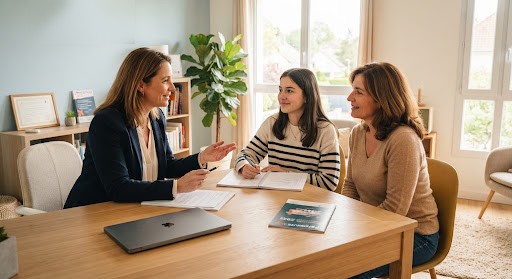
A first conversation
To take stock together, with no commitment

Lilia Todorov, school guidance coach
My name is Lilia Todorov and I am passionate about education and guiding young people.
A teacher by training with a master's degree, I now work at a French university, where I have gained solid knowledge of higher education and its pathways. As a mother of two, I have lived through the questions, doubts and choices that school guidance involves.
It is this double experience, professional and personal, that made me want to support young people and their families with a caring, practical and personalised approach.
What most families go through
Do these scenes sound familiar? You are not alone: they reflect a delicate transition that tens of thousands of parents go through every year.
The shrug
Every time you bring up their future at the dinner table, the answer comes straight back: “Dunno, we'll see later.” The subject quickly becomes a source of tension and withdrawal.
The vague, ever-changing idea
One day they want to do graphic design, the next week law, and in the end “something to do with the environment”. Hard to build a solid strategy.
Fear of getting the balance wrong
Afraid of doing too much and putting toxic pressure on them, or too little and missing key deadlines. Finding the right place as a parent is a real headache.
Information overload
Indigestible ONISEP fact sheets, crowded student fairs with 200 brochures, anxiety-inducing webinars... Too much information kills clear decisions.
A constant sense of urgency
The terms fly by: choosing pairs or trios of specialty subjects, class council forms... You always feel like you're running late.
“Your teenager is neither lazy nor uninterested. They are overwhelmed by decisions whose real impact they struggle to grasp.”
OpinionWay survey for Edumapper: what young people say
Survey of 1,064 young people aged 18 to 24 about their guidance. A few figures, quoted in the study's own words:
Source: OpinionWay survey for Edumapper, “Young people and school and career guidance”, June 2025 (pages 9, 11, 14 and 22).
Read the official report (PDF)Why it is so complicated today
The education landscape has changed radically since the time you made your own choices.
A complex system
- Baccalaureate reform and early choices: from the end of 2nde (Year 11), students must combine 3 specialty subjects without always knowing how this will affect university or prep-school requirements.
- Parcoursup: a national platform (the French higher-education application system) seen as opaque, producing automated rankings and premature stress from the start of high school.
- An explosion of programmes: over 25,000 listed programmes, plus new bachelor's degrees, private schools and double degrees that are hard to assess.
The reality of adolescence
- An identity still being built: at 14-16, passions change, emotional maturity fluctuates and teenagers often protect themselves by seeming detached.
- Projecting yourself is not natural: picturing your working life at 25 feels like science fiction when you struggle to organise this week's timetable.
- Fear of the future and of what others think: the fear of failing, of disappointing their parents or of not doing “like their friends” often blocks any personal initiative.
What families really need
Not a 10-minute online test. Not a twenty-page report gathering dust.
A free space for the teenager to talk
A caring, neutral third party in front of whom the student can dare to express their wishes, fears and doubts without fear of family judgement.
A clear, step-by-step method
No more random guesses: a structured path from the personal profile to real-world realities and accessible programmes.
Parents who are reassured and informed
You stay in the loop thanks to regular reviews, clear explanations of the reforms and a calmer family atmosphere.
A concrete, actionable result
A one-page summary with precise actions to tick off: target open days, choice of options and work-observation placements.
Ready to unblock the situation and restore your teenager's confidence?
Write to me: we will look at their current situation and the most suitable support.
Step-by-step support to help your teenager see more clearly — without imposing a direction on them.
Three sessions with your teenager (including one with the family), a dedicated time for parents, and a practical tool to keep at the end. A method built for 3e and 2nde (Years 10 and 11) — the two years when guidance choices really start to matter — and adaptable in Terminale (Year 13) for Parcoursup.
“Your teenager drives their own choices. My role is to help them discover those choices — not to decide for them.”
Who is this pathway for?
Two turning points where every decision shapes the rest of their education.
In 3e (Year 10)
The first big turning point: the general and technological track, or the vocational track (Bac Pro, CAP, apprenticeship).
- Clarify whether they prefer hands-on or theoretical learning
- Take the drama out of starting high school and the workload
- Make the most of the Year 10 work-observation placement
In 2nde (Year 11)
The decisive choice of 3 specialty subjects for Première (Year 12) and their consistency with future higher-education programmes.
- Choose 3 specialty subjects without regrets or blockages
- Check the entry requirements of post-baccalaureate programmes
- Link interests to careers of the future
Terminale & Parcoursup
Parcoursup application strategy, writing personal statements and preparing for admission interviews at selective schools and programmes.
How the support unfolds
A methodical progression in 6 key stages, designed to defuse anxiety and boost personal motivation.
Discovery call
Initial conversation with the parents
A first phone or video call with the parents to assess the situation: where is your teenager at? What are their school's deadlines? Together we check that the method is a good fit.
Session 1 — Discovering the profile
RIASEC questionnaire & interests
One-to-one interview with the student to explore their personality, strengths, favourite subjects and hobbies. Use of the reference RIASEC model to identify their main career drivers, without any jargon.
Mid-way update for parents
Feedback & alignment
A short call to share first findings with the parents, confirm family practicalities (willingness to move, study budget) and prepare the field research.
Session 2 — In-depth exploration
Research into target careers & programmes
Role-play and active research. The student compares 3 to 4 concrete career options and breaks down the corresponding programmes, their requirements and the working environments.
Session 3 — Feedback and action plan
Handover of the final document
The teenager presents their own conclusions with my support. Handover of the Guidance ID Card and joint approval of a realistic roadmap for the year.
3-month follow-up
Adjustments & celebrating progress
A message or short check-in call to make sure the planned steps have been taken (applications, open days, official choices at the class council).
Exclusive deliverable: the Guidance ID Card
Not a twenty-page report forgotten in a drawer. A concise, readable and actionable document to keep on the desk.
Guidance ID Card
Individual summary document • Guidance coaching
Curious, methodical, strongly drawn to applied sciences, logical analysis and concrete technology projects.
Why this method works
Designed to create a positive dynamic between the teenager and their family.
The teenager in charge
They build their decision themselves, which increases their commitment and boosts their motivation at school.
Informed parents
You are involved in the key stages without daily confrontation.
Long-term follow-up
The support doesn't just stop: I check in again 3 months later.
A living tool
The summary sheet serves as a practical guide for all the year's guidance appointments.
Let's take stock of your child's situation together
Ask me your questions freely through the form, with no commitment.
Let's talk about your child's future
Whether you have questions about the method, the stages of the support, or would like to take stock in a first conversation, feel free to write to me.
Direct contact details
Lilia Todorov, school guidance coach, will reply to you personally within 24 to 48 working hours.
With no commitment at all. Together we look at your child's school record and hesitations, and you leave with a first clear piece of guidance advice.
Send me a message
Fill in this form: I will get back to you quickly.